Back to Topics │ ⇐ Back │ Start: Relativity & Reaction│ Next ⇒
This chapter is the starting point of Relativity and Reaction. It provides the grounding for the framework used throughout the site.
To understand how we think, act, and struggle today, we need to look deep into our biological past. Our brains — the tools we use to reason — are the product of millions of years of evolution. TThe path to modern humans is marked by survival, adaptation, and learning from consequences — the foundation of how we think and act today.
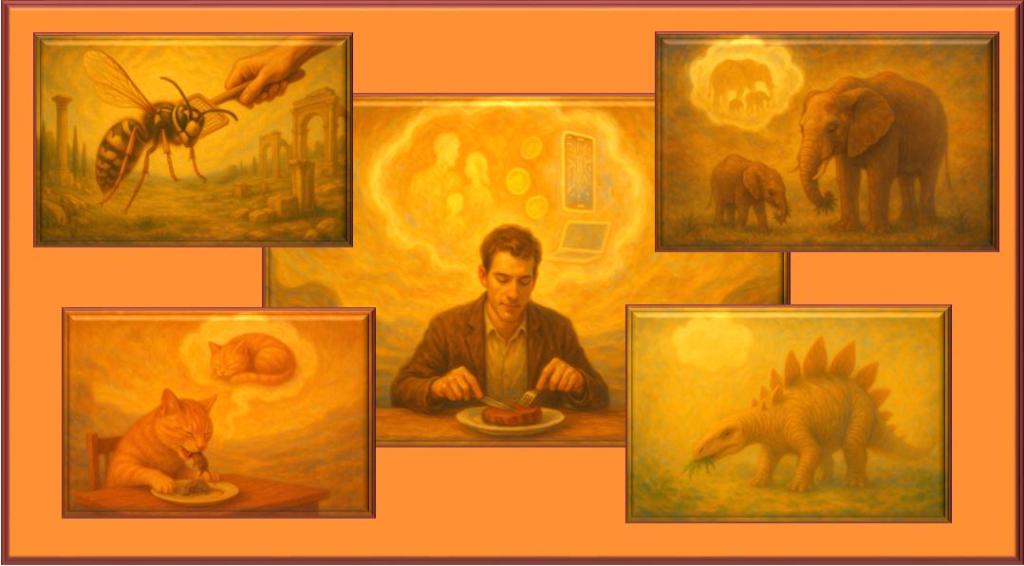
Imagine the Stegosaurus. Despite its massive body, it carried a brain no bigger than a walnut — often described as a “lizard brain,” sufficient only for basic functions. Compared to the first signs of life on Earth, however, the Stegosaurus was already a complex life form. It possessed evolutionary milestones such as a spine, an autonomic nervous system, and a limbic system in its “primitive” brain.
These advances took immense time. The Stegosaurus appeared about 150 million years ago(1), which means evolution spent roughly 96% of Earth’s 3.8-billion-year history(3) producing mostly microbial life before large, complex animals emerged. For most of Earth’s story, the starting point was single-celled organisms; the leap to vertebrates like Stegosaurus marked a profound shift.
For further background on the time frame of Earth’s history, see:
Nerds Cheat Sheet: Earth History Data ⇒
We may scoff at the limited intelligence of the Stegosaurus, but stegosaurs as a group survived for around 10 million years(2). A walnut-sized brain was more than enough for the ecological niche they occupied.
The brain’s central role is to coordinate the body. Even in insects such as wasps, a compact but effective neural system processes sensory inputs and directs behavior. For a deeper look at what brains do and how they relate to the outside world, see:
Nerds Cheat Sheet: Brain Functionality ⇒
Evolutionary demands on the brain — gaining advantage through mutation — always carry consequences:
- Entrapment in a branch. Every species inherits the legacy of its evolutionary path. A cat would need a massive leap to evolve hands; without them, extra intelligence would serve little purpose.
- Trade-offs. Increases in intelligence through larger brains must be balanced against the constraints of body design: fuel demands, birth canal size, growth rates, and thermoregulation.
Fast-forward 150 million years from the time of Stegosaurus, and we meet the mammals: adaptable and responsive. The cat, for example, is agile, perceptive, and wired for stealth. Its brain, though small, is efficient and entirely focused on survival. The elephant, in contrast, boasts one of the largest brains in the animal kingdom — capable of memory, emotional depth, and social awareness.
These differences show how brain size and structure reflect evolutionary pressures. Elephants and cats thrived in their environments with high dietary demands, but neither developed cumulative tool use or symbolic language. For them, more brainpower would have imposed heavy energy costs without clear survival advantage.
Then there’s us. Human brains are not the largest in absolute terms, but they are by far the most energetically expensive. At rest, the human brain consumes about 20% of the body’s energy(6)(7). That is a steep cost unless the benefits are enormous — and they were. With hands freed by bipedal walking, enhanced vision, and complex social structures, early humans occupied an evolutionary “sweet spot.” Added brainpower paid off in cooperation, language, creativity, and eventually civilization.
- Cats are tuned for instinct and rapid response.
- Elephants for empathy and memory.
- Humans gambled on abstraction, foresight, and social complexity.
Evolution rarely rewards extravagance, but in our case, the gamble paid off. For an engineer’s analysis of how little data we have on energy budgets across cats, elephants, and humans — and what consequences that implies — see:
Nerds Cheat Sheet: Food for Thought ⇒
Birds(8) provide another lens. Their brains must be light for flight, yet species like crows and parrots demonstrate problem-solving and symbolic intelligence. They prove that cognitive complexity doesn’t require bulk — only the right design under evolutionary pressure.
Further Food for Thought: Mice and Megawatts
Brains and machines both run on energy — but not in the same league.
- The human brain consumes about 20 watts(9) — less than a dim lightbulb — yet powers memory, imagination, language, and empathy. One “mouse worth” of calories can keep your brain running for hours.
- An AI brain like ChatGPT runs on racks of processors in datacentres that burn thousands of watts(10).
As a playful comparison: imagine ChatGPT had to feed itself. To live the pampered life of a domestic cat — eating well, napping often, and dreaming about the day — it would require a steady diet of mice, one or more per reply. The image is humorous, but the point is serious: nature’s design for intelligence is astonishingly efficient. Where machines devour megawatts, your brain runs on a sandwich.
Layered Architecture
The human brain is often described — for the sake of simplified discussion(11) — as a layered system:
- The brainstem for instinct and survival.
- The limbic system for emotion and memory.
- The neocortex for reasoning, language, and abstraction.
Modern neuroscience recognizes this “triune brain” model as an oversimplification, but it remains a useful way to visualize how older systems continue to operate under newer ones. We carry the instincts of the savanna alongside the capacity for philosophy.
This architecture explains much of our modern struggle — because we are still using a brain shaped for a very different world. We are wired for instant threat detection, close social bonding, and short-term focus. These were essential in small groups on the savanna but can conflict with global, long-term challenges. Social media, political polarization, and climate change all expose this mismatch.
Tribal dynamics shaped our psychology: trust was personal, fairness and status were paramount. These instincts remain visible today in comparison, division, and outrage. Even our most abstract capacities — math, music, language — build on circuits originally evolved for movement, coordination, and memory.
Despite our intellect, much of human behavior is still driven by habit, emotion, and after-the-fact rationalization. Recognizing this is not a weakness. It is a strength — because it lets us reshape our environments and habits to better fit the way our brains actually function.
Mental health challenges like depression, anxiety, and loneliness often reflect this evolutionary mismatch(12). Our ancestors had face-to-face contact, immediate feedback, and clear roles. Modern life often strips those away, leaving us adrift. Yet this also suggests solutions: by realigning our routines and communities with our evolutionary wiring, we can thrive.
Curiosity is perhaps our defining trait. It carried us from stone tools to space telescopes. To question, to explore, to reflect — these are our deepest expressions of humanity.
Looking back, we do not just see bones and brain sizes. We see the roots of thought, emotion, and imagination. We see the long road behind us — full of chance, struggle, and adaptation. And we remember that we are not finished products. — and the world is changing faster than evolution.
What comes next depends on our ability to move beyond instinct, and use observation, consequence, and action with intent.
Endnotes — Looking Back in Time
Edition 1.01 02/12/2025
📖 Series Roadmap
- Forward: A Little Background
- Introduction: Action, Reaction, and the Human Paradox (16.09.2025)
- Looking Back in Time: The Development of the Human Brain (23.09.2025)
- Abstract Senses: Enhancing the way we see the world outside (30.09.2025)
- Bias as a Concept & Climbing the Stairs: Pattern Recognition & Everyday Tasks (07.10.2025)
- Abstract Feelings and Abstract Senses (14.10.2025)
- Motivation (04.11.2025)
- The Social Knowledge Base (11.11.2025)
- Potential (18.11.2025)
- The Subliminal Way We Go Through Life (26.11.2025)
- Taking Responsibility (02.12.2025)
- Fishing for Complements (22.12.2025)
- Peter and Fermi (22.12.2025)
🔗 R&R Navigation
Back to Topics │ ⇐ Back │ Start: Relativity & Reaction│ Next ⇒
 Take a Second Thought
Leave a comment