Back to Topics │ ⇐ Back │ Start: Relativity & Reaction│ Next ⇒
Nerd Cheat Sheets: – Pattern Recognition
At its core, this chapter is about automatic skills and the biases inside them—how they help us, where they fail, and how to notice the difference.
Pattern Recognition
The first step in dealing with any situation is to understand what’s really going on. As we move through life, we tend to recognise situations without consciously thinking about them.
Most of the time, we walk down familiar roads past houses, shops, and cars—often on mental autopilot. We might notice the people we pass, offering a quick nod or polite smile, but little else. It’s like sitting on a plane with the autopilot engaged.
Beneath that calm surface, however, our subconscious is wide awake—constantly scanning for danger and opportunity. Think of it like Arnold Schwarzenegger’s Terminator view: scanning in red, locking onto objects, assessing their threat or potential advantage.
When we look at something, our brain instantly tries to decide what it is. To do that, it compares what we see with patterns we’ve stored from past experience. If we have no comparison, we step back, think, and decide whether we need to know more about what we’re seeing—a deliberate, conscious System 2 process.
When we recognise something familiar, System 1 identifies it with little conscious effort, drawing on stored patterns and prior experience. This is pattern recognition. The accompanying Nerd Cheat Sheet explores this ability we all share—how it forms, how it helps, and where it sometimes fails.
Nerd Cheat Sheet: Pattern Recognition
Pattern recognition doesn’t begin when we open our eyes—it begins developing in the womb. Long before birth, our brains are tuning into rhythm, light, and motion. Through this early sensitivity, we start building the foundations of understanding, training the neural fabric that will one day help us see, hear, and interpret the world. Before we learn language or movement, we learn pattern—and through pattern, we learn everything else.
Pattern recognition is our first true skill, and every other skill we acquire is built through it. Over a lifetime, we learn hundreds of skills, yet each of us masters them differently. We all share the same basic brain configuration, but what we do with it varies enormously.
Sports, for instance, demand strength and coordination—qualities not everyone has in equal measure. Music can be learned by most people, but becoming a virtuoso is rare. Practice keeps you sharp, but there’s always a faster gunslinger somewhere—you just hope he doesn’t show up at your door.
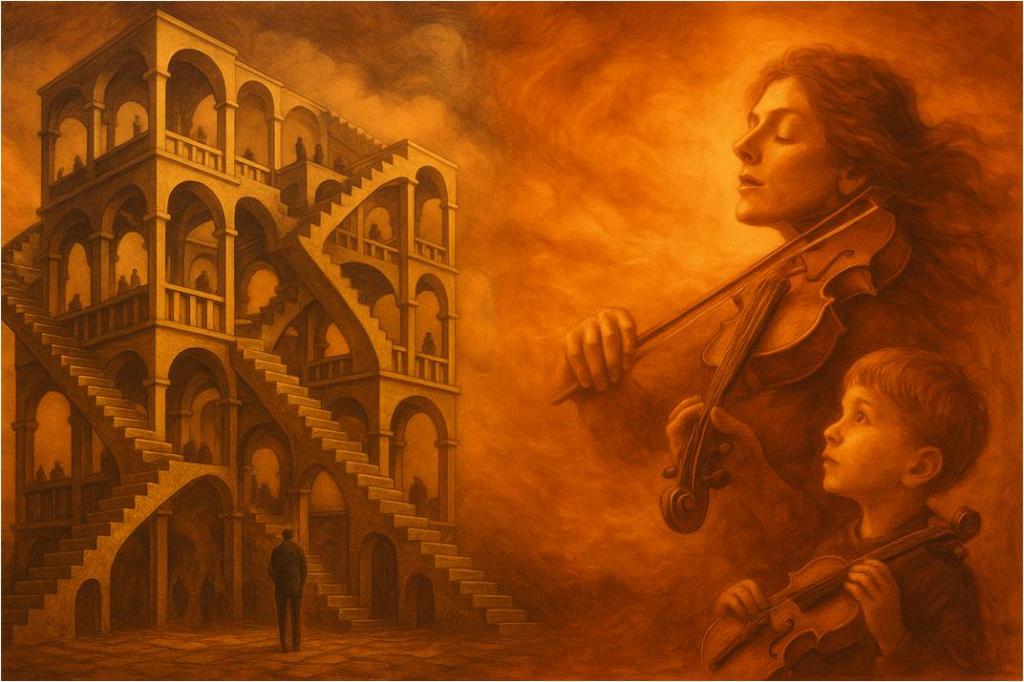
And oddly enough, even a task as simple as climbing the stairs is a skill.
Climbing the Stairs
It’s hard to appreciate the depth of learning involved in something as simple as climbing stairs. We rarely give it any thought as adults, yet getting from one step to the next without stumbling is a masterclass in coordination, balance, muscle memory, and timing.
As infants, we were clueless. We pulled ourselves up, fell, tried again, wobbled, cried, succeeded a few times, and eventually mastered it. After that, we rarely thought about it again.
The ability to walk upstairs smoothly is the result of a refined automation process—a learned behaviour so deeply embedded that it no longer requires conscious thought. Why is that important? Because the brain’s ability to store and recall behaviour without conscious processing is fundamental not only for physical actions, but also for how we perceive the world, make decisions, and act in complex situations.
Automation saves energy but hides assumptions. It frees up cognitive resources for new or complex challenges, but it also means we sometimes rely on stored responses, habits, or shortcuts—especially under stress or time pressure—when a slower, more reflective approach would be better.
This is where bias comes in.
System Bias as a Cognitive Shortcut
In technical systems, a bias is often introduced deliberately to guide behaviour or decision-making when data are incomplete. In artificial intelligence, for example, bias helps a system make a best guess when perfect information isn’t available. The same is true for humans.
We develop biases as mental shortcuts—heuristics—that allow us to make quick decisions without analysing every situation from scratch. In many cases, this is efficient and necessary. Imagine re-evaluating every social cue or risk assessment from zero every day; you’d never get out the door.
Biases serve us well when:
• The environment is familiar and stable.
• We need to act quickly.
• The cost of being wrong is low.
But biases become dangerous when:
• The context has changed and we don’t realise it.
• We mistake assumptions for facts.
• Our emotions hijack our ability to pause and reflect.
Climbing stairs is a harmless example. We don’t rethink it because it almost always works. But imagine the stairs are covered in ice—suddenly, the automated approach can get you hurt. You must re-engage conscious thought.
Just like language or etiquette, the automation of climbing stairs is part of the broader catalogue of skills we internalise early, often shaped by the people around us. These embedded habits form the foundation of many of our daily choices.
The Balance Between System 1 and System 2
Psychologist Daniel Kahneman described two modes of thinking that shape nearly every decision we make.
Put simply, the cycle of observation, consequence, and action can be handled in two very different ways:
System 1 flow:
Observation → (assumed consequence via a “recipe”) → Action
System 1 relies on patterns from the past. If a situation looks familiar, it quickly applies a ready-made recipe and moves straight to action.
System 2 flow:
Observation → Consequence (tested, adapted, weighed) → Action
System 2 takes over when a situation can’t be handled by a shortcut. It slows down, checks assumptions, and works toward a custom solution.
Most of our daily actions come from System 1. It’s fast and efficient. But when the situation changes, we need System 2 to take over—to reassess, pause, and adapt.
The challenge is knowing when to make that shift—and acting on it—because that moment often determines whether we make a wise decision or a avoidable mistake. The signal to switch systems is often a feeling: confusion, frustration, fear, or even excitement. These are cues from the body to slow down and think things through, yet they’re easy to ignore or suppress.
As we’ll revisit in later chapters, this System 1/System 2 distinction is central to many patterns of human behaviour.
Learning to Listen
This book promotes a three-step pattern—Observation, Consequence, Action—as an underlying framework for intelligent life. The same sequence applies to how we handle our mental habits and biases:
• Observation: What am I reacting to? What triggered this response?
• Consequence: What could happen if I act on autopilot right now?
• Action: Do I need to pause and reassess, or is this a safe moment for a routine response?
This framework doesn’t guarantee success, but it increases the odds of making better decisions. The goal isn’t to eliminate bias—it’s to recognise when it’s helping and when it’s hurting.
Conclusions
This chapter is about the skills we pick up over the course of our lives. They perform useful work and act automatically unless told otherwise. The biases they hold are usually non-prejudicial. These biases exist to improve success, accuracy, and repeatability—they’re the weightings built into the mechanism.
Such biases are not necessarily emotional. They arise from skill, habit, and repetition. These skills act consistently and align with System 1 thinking—fast, automatic, and intuitive. Yet even these efficient systems are vulnerable to systematic errors: slips, lapses, and false assumptions. Their behaviour can be manipulated by consistent patterns in the stimuli, much like the knee-jerk reflex elicited by a neurologist.
The bias described here is similar to the bias found in man-made automated systems. We can think of it as mechanical bias—a functional weighting within skills linked to the physical senses. The drives to these senses are generated directly by sense organs: bright light causes discomfort, heat causes pain, sudden motion triggers balance correction. These signals can invoke reflexive responses.
By contrast, abstract senses have no direct physical input. We cannot see or touch fear itself, yet when we perceive we are surrounded by wolves, we feel fear. The stimulus is internal—an interpretation of pattern, not a physical event. This aspect will unfold further in later chapters, but we close this section by reflecting on skill-based bias and its consequences.
When we consciously observe ourselves using these skills—much like bird-watching our own minds—we are engaging System 2. This conscious interaction is what allows reflection, correction, and growth.
Making System Bias Work for You
When recognising patterns, notice when nuance matters. Before the abstract senses intervene—what Buddhists might call being in the moment—pause to test your assumptions:
• The optics may be deceptive—the tone of a voice may reflect a bad day, not a personal attack.
• The smile on the salesperson’s face might simply be satisfaction, not manipulation.
• The speed of the car and the condition of the road may not match—driving is a skill like climbing stairs, but the consequences of a lack of attention are far greater.
We can drift into our own worlds when it’s safe to do so, but “not paying attention” remains the root cause of too many tragedies.
Edition 01.01 02.12.2025
Nerd Cheat Sheets:
– Pattern-Recognition
Taken from YouTube T-800 CSM 101 Ankunft | Terminator 2 – Tag der Abrechnung [Remastered]”
Posted 16.04.2019
📖 Series Roadmap
- Forward: A Little Background
- Introduction: Action, Reaction, and the Human Paradox (16.09.2025)
- Looking Back in Time: The Development of the Human Brain (23.09.2025)
- Abstract Senses: Enhancing the way we see the world outside (30.09.2025)
- Bias as a Concept & Climbing the Stairs: Pattern Recognition & Everyday Tasks (07.10.2025)
- Abstract Feelings and Abstract Senses (14.10.2025)
- Motivation (04.11.2025)
- The Social Knowledge Base (11.11.2025)
- Potential (18.11.2025)
- The Subliminal Way We Go Through Life (26.11.2025)
- Taking Responsibility (02.12.2025)
- Fishing for Complements (22.12.2025)
- Peter and Fermi (22.12.2025)
🔗 R&R Navigation
Back to Topics │ ⇐ Back │ Start: Relativity & Reaction│ Next ⇒
 Take a Second Thought
Leave a comment