Back to Topics │ ⇐ Back │ Start: Framing │Forward => │
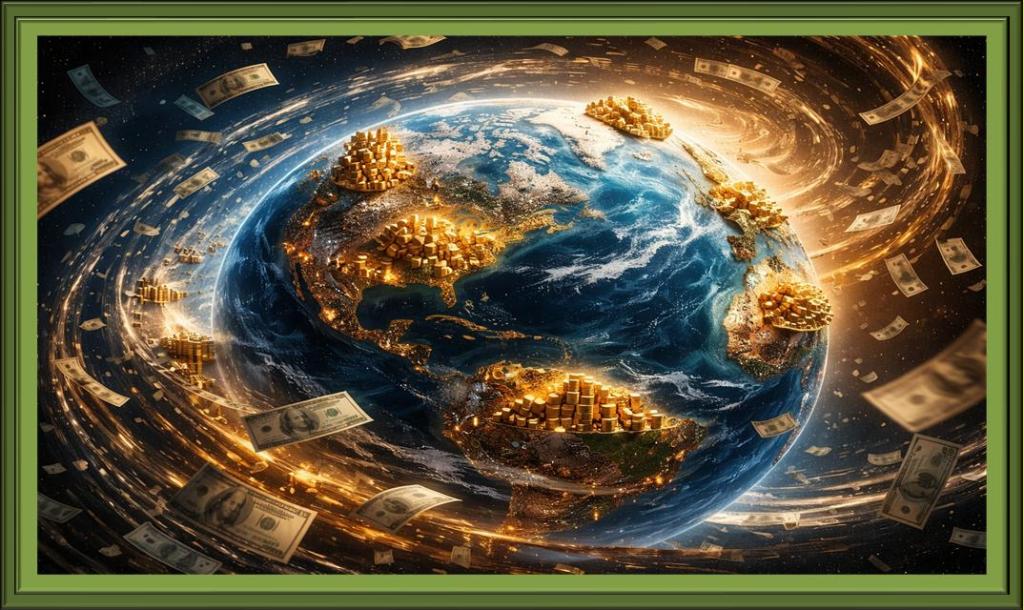
At a global scale, money does not sit still. It moves—circulating, accumulating, and redistributing in ways that are not always easy to see.
Money was first touched on in the Cheat Sheet Money – It’s a Gas from Reality and Relativity and examined locally in Balancing the Books. The purpose of this section is to look more closely at what money actually is, how it works, and what its existence implies for us.
For most of us, money allows us to balance our needs against our resources. We exchange effort for money, and money, in turn, translates the value of our time and skills into something comparable with the time and skills of others. When we buy something, we instinctively relate its price to how much of our own time it took to earn. This relationship largely defines our standard of living and forms the cornerstone of a free-market economy.
And yet, when viewed at a global scale, finance appears far more complex than this simple exchange.
The exact origins of money are not the focus here. What matters is that its existence enables two key mechanisms:
- A comparative medium for the exchange of diverse goods and services
- A mechanism for determining state levies, used to maintain infrastructure and manage society
The reason symbols of the state appear on money is not accidental. It is closely tied to the second function, which is arguably the primary driver behind the widespread adoption of money.
To explore this more clearly, consider a fictional example.
A Golden Era
A King and Queen rule a small, closed kingdom. They are responsible for roads, schools, and hospitals, and they own and operate the kingdom’s gold mines.
The subjects include farmers, blacksmiths, doctors, miners, bakers, and tailors—each providing essential goods or services.
When the system is in balance, the monarchy levies taxes to fund its responsibilities. This creates a continual flow of money between the monarchy and its subjects. Laws enforce tax collection, securing both the authority of the monarchy and the continued use of its currency.
Within this system, money circulates among the subjects, who collectively determine the relative value of different trades and services.
In the short term, the monarchy can increase spending—through banquets or major projects—by mining more gold. This gold is exchanged for goods and services, increasing the money held by the population.
As the money supply increases, inflation follows. Prices adjust as relative values recalibrate.
Conversely, the monarchy can increase taxes without increasing spending, stockpiling gold instead. This reduces the money held by the subjects and leads to deflation, as economic activity adjusts to lower available money.
The key point is this: the gold plays no active role in the execution of these trades. It is not consumed, transformed, or created by the work being done. Its role is symbolic—a conserved medium that enables comparison and exchange.
A Golden Era as a Closed Balance
This system can be treated as a closed balance with respect to money. Gold circulates between the monarchy and its subjects but does not leave the system.
While the King determines how much gold exists, he does not directly control how it is distributed among trades and individuals. That distribution emerges from interactions between the subjects themselves.
The King does, however, control his own spending. Through this, he indirectly determines how much real resource—goods and services—is drawn from the population. In effect, the monarchy controls the flow of money, while the population determines its allocation.
The quality of the King’s financial management is therefore directly coupled to the wellbeing of his subjects. Excessive taxation or reckless spending produces immediate and visible consequences, while sensible policy stabilizes the system. This creates a natural feedback loop.
This system has several defining features:
- A clearly identifiable authority responsible for money issuance and taxation
- Governance over a localized population
- A feedback loop that responds quickly to policy changes
Because the system is small and closed, imbalances are difficult to hide. Inflation, deflation, prosperity, and hardship appear quickly, making cause and effect easier to observe.
This closed-system principle underlies all financial systems in which money supply is controlled by institutions responsible for state infrastructure and security. Modern systems are more complex and often no longer closed, but the core mechanism remains.
The simplicity of this system makes its behaviour easy to see. The real world is less accommodating.
The Real World
Modern Gold Mines
Monarchies still exist in parts of the world, but in most modern societies governance is implemented through state infrastructure. One component of this infrastructure is dedicated to financial management and is commonly referred to as the treasury.
The treasury operates what can be thought of as the modern equivalent of gold mines and tax collectors. In practice, this role is distributed across many departments and mechanisms, making the system far more complex than the simple monarchy described earlier.
Historically, many treasuries held gold reserves traded within financial markets. Over time, money moved from gold coins to banknotes with little intrinsic metal value, then to cheques and cards, and finally to today’s predominantly digital transactions.
In modern economies, most money never appears in a wallet. It exists only as numbers stored in computer memory. The intrinsic value of that memory, as a physical resource, is effectively zero.
When additional funding is required, the state no longer “mines” gold. Instead, it offers savings mechanisms to those with surplus money, commonly in the form of state bonds. These promise a fixed return and set a benchmark interest rate that private lenders and borrowers must compete against.
Rather than creating new gold, the state uses a portion of collected tax to service bond interest. The money raised through bond sales is spent to cover short-term expenditure, much like an individual taking a loan to fund a purchase before they have the cash available.
This provides a simplified framework for understanding modern state finance. While mechanisms are more abstract and feedback slower, the underlying principles remain unchanged.
The Private Sector
Trading state-based savings schemes adds further layers to how money is distributed and connects states through cross-border investment.
In its purest form, a treasury balances the books—collecting enough tax to meet its obligations. The ability to issue bonds introduces opportunity by allowing money to be shifted across time.
State bonds temporarily transfer money from investors to the state. Similar transfers occur between private borrowers and lenders. An individual car loan follows the same underlying mechanism.
By setting the lowest-risk interest rate through bonds, the state establishes a reference point. Investors seeking higher returns look elsewhere, and the private sector competes by offering higher interest rates. These rates underpin mortgages, business loans, and consumer finance.
Opportunity in this system is largely a function of time.
Long-dated bonds introduce delayed feedback. Over time, fixed interest rates may become more or less attractive depending on inflation, growth, and global conditions. This delay is where much of the complexity—and opportunity—of the private sector arises.
Shares
Shares are private-sector equivalents of bonds, issued by companies rather than states. A share represents ownership and may provide dividends, though these are not guaranteed.
Company incentives favour growth. Growth may increase dividends, loosely analogous to interest, but speculation weakens this relationship. Share prices often move independently of dividends, driven by expectations and sentiment.
Dividends are taxed, creating tension between state revenue and investor incentive. This adds another destabilizing influence.
Shares carry higher risk than state bonds but offer higher potential returns. Gains and losses depend strongly on timing.
A realised profit exists only at sale. For the wider economy, the persistent benefit of shares is the dividend—real value produced and distributed. If a company fails, this benefit disappears regardless of past price movements.
Speculation
Bonds encode obligations across time, while shares represent ownership whose value emerges from future system behaviour. While shares carry legal rights, the distinction remains economically useful.
Tax, bonds, and shares form interacting financial domains with competing objectives. Improvements in one domain may destabilize another. What binds them together is spare money and the search for return.
This interaction opens the door to speculation and leverage.
Speculation is business activity aimed at profiting from future price changes. When successful, it generates additional spare money. When it fails, spare money disappears, tightening the system.
Speculation acts as an amplifier—accelerating both growth and contraction—driven by delayed feedback rather than malice.
Spare Money
Most of the world’s population has no spare money. Life is spent balancing the books, with income consumed by necessity.
In many Western states, governments speculate on behalf of citizens through pensions and social systems, funded via tax. Individual savings are often held in low-risk accounts near bond rates.
Banks aggregate these savings, reducing overhead and creating deployable spare money. Pension funds operate similarly.
Those fortunate enough to accumulate surplus directly can deploy it at scale, sometimes generating returns exceeding salary.
Once spare money exists, access to financial markets expands and amplification becomes possible.
Risk
Roulette illustrates the distinction between short-term uncertainty and long-term expectation. Over time, the house wins.
Well-run companies should, over sufficient time, resemble the house rather than the gambler. In the short term, however, markets behave like gambling.
Investment requires commitment. Speculation tempts overreach. Leverage narrows the boundary between house and gambler.
This often manifests as overconfidence, hidden mistakes, and corruption. When these occur, spare money is destroyed and must be rebuilt through productive work.
Market crashes reflect repeated feedback failures, amplified by leverage and speed. Information technology has accelerated, not created, this behaviour.
Why
The purpose of this section is to demystify financial language—not to defend or glorify finance, but to reveal its mechanisms.
Tax is often experienced as a burden because its purpose is obscured. Yet it underpins collective choices and shared risk.
Finance appears complex because it is regulated. Complexity creates mystery. Beneath it, the motivations remain simple.
To “follow the money” is to observe where it flows, accumulates, and is destroyed.
If this section has done its job, financial news may sound less alarming—and perhaps even faintly amusing—because the dish is usually cooked much hotter than it is eaten.
📖 Series Roadmap
- ######:
- Balancing the Books (23.04.2026)
- Money Makes the World Go Around (23.04.2026)
- Framing (23.04.2026)
- Peanut Allergies (24.04.2026)
- Identity (24.04.2026)
- Exposure (26.04.2026)
- The Conservation Principle (26.04.2026)
- A Live Example (28.04.2026)
- Why Framing (28.04.2026)
🔗 R&R Navigation
Back to Topics │ ⇐ Back │ Start: Framing │Forward => │
 Take a Second Thought
Leave a comment