Back to Topics │ ⇐ Back │ Start: Framing │Forward => │
The purpose of this section is to walk through an example together, applying Observation–Consequence–Action (O-C-A) and the conservation principle to expand our understanding of a topic.
In the section The Subliminal Way We Go Through Life and the Nerd Cheat Sheet: Exploring Relativity in the blog Relativity and Reaction, some of the disagreements and developments in physics surrounding Albert Einstein were examined. The intention there was not to settle the debate, but to illustrate something more human: even the best thinkers are limited by the ways we communicate, interpret evidence, and resolve disagreement.
To explore this further, it helps to move back in time.
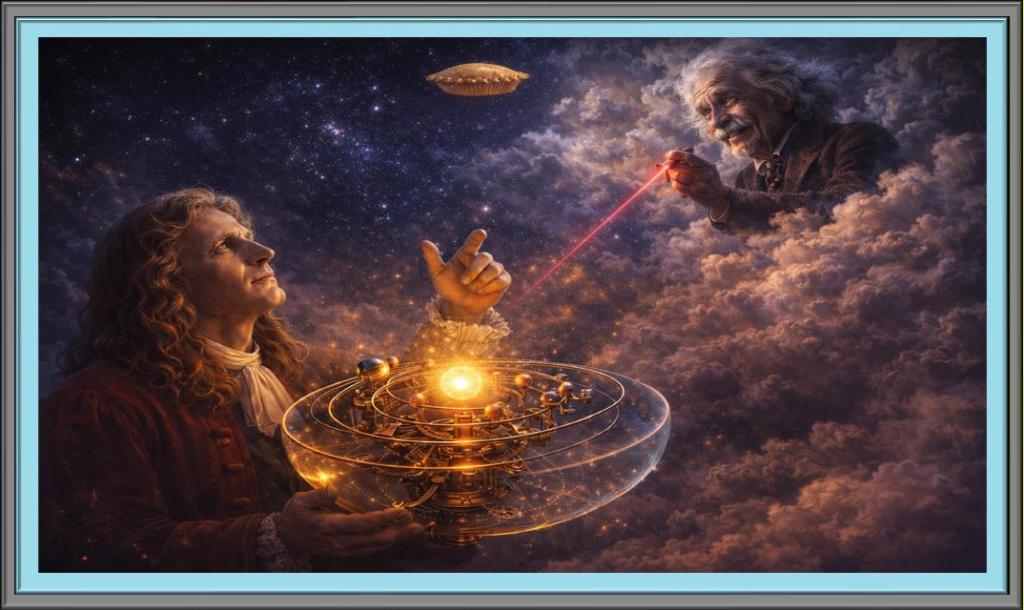
Folk lore tells us that Isaac Newton was sitting under an apple tree when an apple fell on his head. Whether the story is literally true or not is less important than the question it represents. Newton might have asked himself:
Why did the apple fall down rather than up?
Extending the same line of thinking, another question follows naturally:
Why do the planets move around the Sun instead of drifting away?
Newton’s frame of observation was the solar system. From the repeated observation of falling objects on Earth and the motion of the Moon and planets in the sky, he proposed that the same principle might govern both.
The conclusion he reached was that there must be a mutual attraction between masses. The apple and Newton’s head attract each other, and in the same way the Sun and the planets attract each other.
The event in the orchard was only one observation among many, but together they formed threads pointing toward a common explanation.
Newton’s Laws of Motion
Most of us were introduced to Newton through three laws of motion.
1) Force and acceleration
F = m x a
Force equals mass times acceleration.
This law tells us how motion changes when a force is applied.
2) Conservation of momentum

Momentum is conserved when objects interact if no external forces act on the system.
In simpler terms, when motion is transferred between objects—for example in a collision—the total momentum remains the same.
3) Action and reaction
For every action there is an equal and opposite reaction.
If you lean on a wall, you push against the wall. At the same time the wall pushes back on you. That opposing force is what allows you to remain upright.
Vectors: Size and Direction
From school days it is useful to remember that velocity is a vector.
A vector has two parts:
- Magnitude (how large it is)
- Direction
Speed only tells us how fast something is moving.
Velocity tells us how fast and in which direction it is moving.
Force is also a vector. It has both magnitude and direction.
In the equation
F = m x a
the direction comes from the acceleration, which tells us how the velocity of an object is changing.
In these equations, mass appears as a scalar—it simply tells us how much of something there is and has no direction.
Mass, Weight, and Measurement
This is where everyday convention can be misleading.
Mass is measured in kilograms or pounds, and we commonly use a scale to determine it. However, a scale does not actually measure mass directly—it measures force.
When an object is placed on a scale, gravity pulls it toward the Earth. The scale pushes back with an equal force, creating a balance.
The relationship is:
F = mg
Rearranging gives:

So what the scale really measures is the force produced by gravity, and we calculate the mass from that force.
The object’s weight is the force with which gravity pulls it toward the Earth. The Earth pushes back with an equal and opposite force through the surface supporting the object. The result is a stalemate and the object remains motionless.
In Newtonian physics, mass is treated as an intrinsic property of an object—it does not change simply because different forces act on it. If that assumption were ever found to break down, the limits of Newton’s theory would be revealed.
Developing Newton’s Gravity Model
From the time of Copernicus, it was understood that the planets orbit the Sun, and their positions could be tracked with increasing accuracy. Later, Johannes Kepler showed that these orbits are elliptical rather than perfectly circular.
An object moving in an ellipse is continually changing direction as it travels. Even if its speed were constant, this change in direction means the object is accelerating. For Newton, this implied that forces must be acting on the planets.
Using his second law,
F = m x a
an acceleration requires a force.
From Apples to Planets
If the planets continually change direction while orbiting the Sun, some force must be acting on them. By the same reasoning, the planets must also exert a force on the Sun.
The familiar story of the falling apple suggests a possible clue. A small object such as an apple tends to move toward a much larger object such as the Earth. The force involved acts on both bodies, but the effect depends on their masses.
This idea is consistent with inertia. Large bodies resist changes in motion more strongly than small ones.
A similar pattern appears in the motion of the planets:
- Inner planets move faster → stronger acceleration
- Outer planets move slower → weaker acceleration
Yet all of these motions occur around the same Sun.
Whatever force governs this motion must extend outward from the Sun and vary with distance.
Centre of Mass Simplification
A see-saw balances when the weights on both sides are matched. In that situation, the system effectively acts through a single point—the pivot. This point represents the centre of mass.
Using this idea, we simplify the solar system:
- Each body becomes a point mass
- The system reduces to interactions between centres of mass
Distance and the Inverse-Square Idea
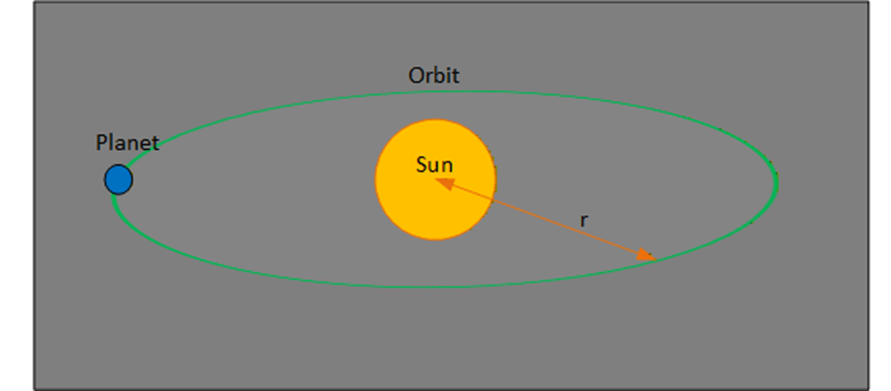
If the Sun’s influence spreads uniformly in all directions, we can visualise how it weakens with distance.
A flat “plate” analogy suggests the idea—but space is three-dimensional.
The Sun’s influence spreads over expanding spheres. At distance 

As distance increases, the same total influence is spread over a larger area, reducing its intensity.
Two Masses, One Interaction
Gravity is not a property of a single object—it is a relationship between two objects.
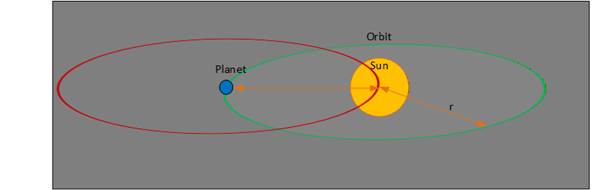
The planet acts on the Sun, and the Sun acts on the planet. These interactions are equal and opposite.
Any valid expression must therefore:
- Include both masses
- Be symmetric
- Go to zero if either mass is zero
Multiplying the masses satisfies these conditions:

Putting It Together
Combining mass interaction with distance dependence:

Introducing a constant of proportionality:

Matching Observation
By applying Kepler’s laws of planetary motion and developing the mathematics further using calculus, Newton showed that this inverse-square force produces elliptical orbits.
A simple relationship explained the motion of the planets.
With one exception: Mercury.
Taking the Long Way Home
Somewhere along the way, you might hear Take the Long Way Home playing in your head.
So what was the point of taking the long route?
- Given the answer, the question looks simple
- We still do not know what gravity is
- The constant
embeds empirical assumptions
- The mechanism of interaction remains unclear
Newton’s law is a model that fits observation extraordinarily well—but it does not explain the underlying mechanism.
Even phenomena like gravitational slingshots show interaction, but do not fully explain what is being transferred or how the “field” operates at a fundamental level.
Final Reflection
Newton’s discoveries are sheer genius.
But their deeper value may be this:
They do not just show us how the universe works.
They show us, very clearly, where our understanding stops.
Interestingly, the form of Newton’s gravity equation is not unique in physics.
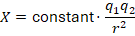
This structure appears whenever an influence spreads outward from a source through space.
This behaviour is captured by Gauss’s law, which describes how a conserved influence distributes from a point source under certain conditions.
For this form to apply, the following assumptions are implicit:
- The influence spreads equally in all directions
- It is not consumed as it propagates
- Space behaves uniformly (no preferred direction or distortion)
Under these conditions, the influence spreads over the surface of an expanding sphere.
Since the surface area of a sphere grows with the square of its radius, the intensity of the influence must decrease proportionally to:

Examples of This Behaviour
This inverse-square structure appears in multiple areas of physics:
- Electrostatics — Coulomb’s law
- Light and radiation intensity
- Elements of magnetic interaction
In each case, two things interact through a field that spreads through space.
Frames, Fit, and Reality
Gauss’s law is not just a formula—it is a framework.
Newton identified the inverse-square law from observation and reasoning.
Gauss later showed that this form is not unique to gravity, but a natural consequence of how influence spreads through three-dimensional space.
Like any framework, it works under certain assumptions. When those assumptions hold, the results are remarkably accurate. When they do not, the framework begins to show its limits.
This is where physics becomes real.
We build models that simplify the world. These models are not reality itself—they are tools that help us navigate it. Their usefulness depends on how well their assumptions match the situation.
In many cases, even rough assumptions lead to very accurate and useful conclusions. That is why Newton’s model remains extraordinarily powerful in engineering and everyday physics.
The Dilemma
Once we recognise that every model carries assumptions, a new responsibility emerges.
We can no longer treat our frameworks as absolute.
Instead, we must ask:
- Where does this model apply?
- Where might it begin to fail?
- What assumptions am I making without noticing?
Understanding these limits sharpens judgment.
Where Newton Ends—and Something Else Begins
This boundary is precisely where the work of Albert Einstein begins.
Newton’s model could not fully explain the motion of Mercury. The discrepancy was small, but real.
Einstein’s theory of General Relativity resolved this by changing the framework entirely.
And yet, in most practical situations, Einstein’s theory reduces back to Newton’s.
Final Thought
Newton’s law is not just a description of gravity.
It is an example of something deeper:
A pattern that emerges when influence spreads through space under simple assumptions.
The equation works.
The predictions match observation.
But the deeper lesson is this:
Understanding does not come from the equation alone—
it comes from knowing the assumptions that make the equation true.
One of the key observations that shaped Albert Einstein’s thinking was that the speed of light appears to be constant.
This is not an explanation of what light is, but a statement about how it behaves within the limits of what we can observe. Like all observations, it has been verified across a wide range of conditions, yet it remains grounded in measurement rather than underlying mechanism.
Einstein’s step was to treat this observation not as something to be explained, but as a constraint that must always hold. From this, a wide range of consequences follow. Space and time adjust to ensure that the speed of light remains constant.
In this sense, Einstein’s approach follows a similar pattern to Newton’s, but operates at a deeper level of constraint.
Newton built his model of gravity around the observed motion of the planets.
Einstein built his framework around the observed behaviour of light.
In both cases, a small set of trusted observations defined the structure of the model. The success of the theory lies not in proving those observations, but in how much of reality falls into place when they are assumed to be true.
At its core, this is what both Newton and Einstein were trying to do:
Not to find absolute truth, but to improve predictability and understanding.
That is what humans do.
Einstein extended Newton’s work using new observations and a different framing of the problem. In doing so, he did not discard Newton—he revealed the limits within which Newton’s model applies.
The purpose of this exploration is not physics alone.
This journey through Newton’s garden shows that the same thought processes—
framing, simplifying, testing, and recognising assumptions—
apply equally to the problems we face in everyday life.
Understanding improves when we recognise the limits of our models.
Better decisions follow when we know when to change the frame.
📖 Series Roadmap
- ######:
- Balancing the Books (23.04.2026)
- Money Makes the World Go Around (23.04.2026)
- Framing (23.04.2026)
- Peanut Allergies (24.04.2026)
- Identity (24.04.2026)
- Exposure (26.04.2026)
- The Conservation Principle (26.04.2026)
- A Live Example (28.04.2026)
- Why Framing (28.04.2026)
🔗 R&R Navigation
Back to Topics │ ⇐ Back │ Start: Framing │Forward => │
 Take a Second Thought
Leave a comment