Take a Second Thought
Take a second thought — because the first one isn’t always enough
Category: Relativity and Reaction (R&R)
-
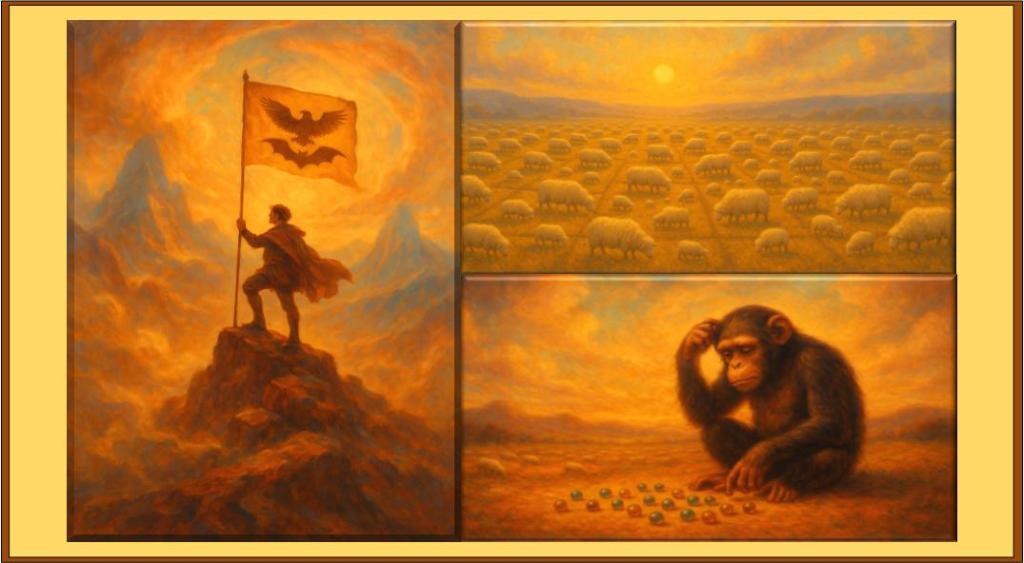
Abstract senses are about attaching context to the world as seen by our six senses. For humans the fight for a reasonable living standard is function of – What you know and how you learn more about the outside world -Applying your understanding of the outside world
-
When Homo sapiens shopped for senses, he didn’t buy the luxury package. He chose good-enough sight, fit-for-purpose hearing, modest smell and taste, and high-fidelity touch in the fingers. Later he built telescopes, microphones, flavourings, and instruments to upgrade the set.
-
When Homo sapiens shopped for senses, he didn’t buy the luxury package. He chose good-enough sight, fit-for-purpose hearing, modest smell and taste, and high-fidelity touch in the fingers. Later he built telescopes, microphones, flavourings, and instruments to upgrade the set.
-
Living things rely on their senses to survive—but humans go one step further. We don’t just sense the world; we derive meaning in a more extensive way than any other species on the planet. This chapter explores how that ability evolved—and how we can use it better.
-
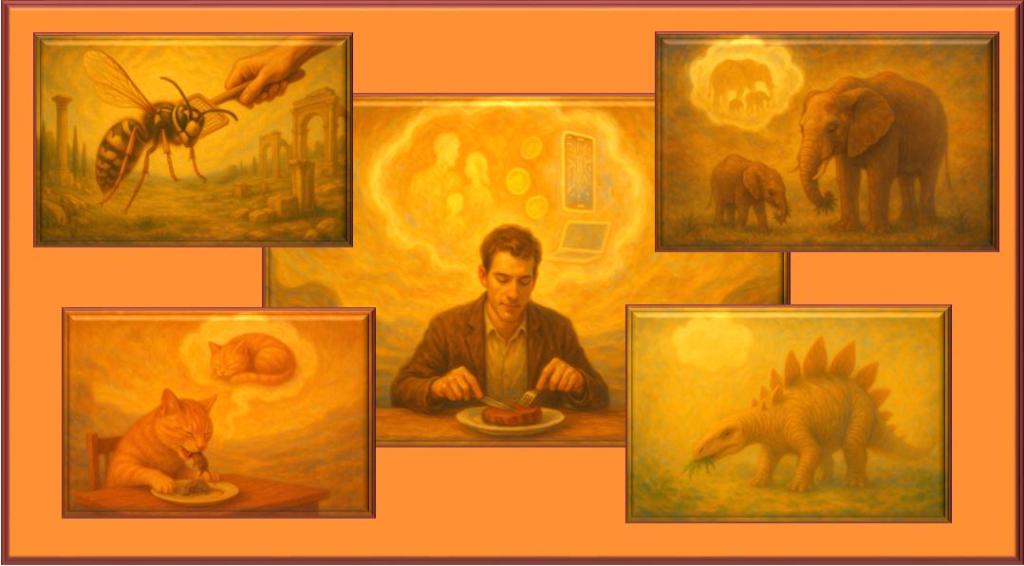
To understand how we think, act, and struggle today, we need to look deep into our biological past. Our brains — the tools we use to reason — are the product of millions of years of evolution. The path to modern humans is marked by survival, adaptation, and legacy.
-
“You are what you eat.” usually refers to poor dietary habits. On a deeper level, it points to something more profound: the relationship between energy intake and its use. Nowhere is this trade-off clearer than in the cost of running a brain.
-
Humans brain carries the legacies evolution : Older systems (hypothalamus, amygdala, brainstem) = System 1 survival engine. Newer systems (neocortex, prefrontal cortex) = System 2 deliberation and planning. Recognizing this dual architecture helps explain both strengths and vulnerabilities: reflexes saves us in an instant, but can also mislead us in the modern world
-
This post considers human intelligence. While other animals such as octopi and birds show impressive problem-solving, only humans scaled intelligence into a planetary force. To apply the principles of observation, consequence, and action, I start with ten fixed points in Earth history.
-
To understand how we think, act, and struggle today, we need to look deep into our biological past. Our brains — the tools we use to reason — are the product of millions of years of evolution. The path to modern humans is marked by survival, adaptation, and legacy.
-
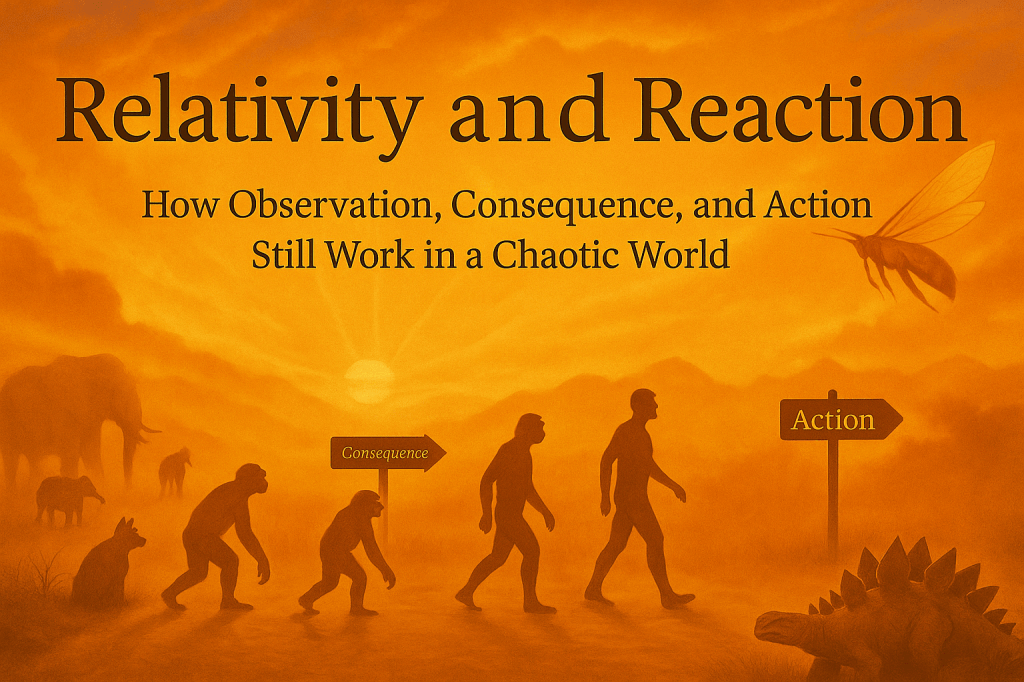
As part of further training by my firm as an engineer I attended a Kepner-Tregoe seminar. This introduced me to a strategy for critical thinking. Later in Germany I attended a course on “How to Give Feedback Back” — this brought my attention to the pattern of observation consequence and action.
 Take a Second Thought