
Following the money behind Germany’s E10 pump price
<= Back │Back to Newsroom│Back to Where did the Windfall Fall │ Forwards =>
Nerd Cheat Sheet: Gasoline Pool Working Residual Model
This article explores the principal factors contributing to gasoline prices in Europe. As a starting point, it examines the development of German E10 pump prices over the period 2020 to 2026.
Modelling the Components of German E10 Pump Price
The model uses monthly average snapshot data from the following months to estimate equivalent average snapshots of gasoline pool working residue between July 2020 to July 2026.
- The Working Residuals
(Sales price of product – Cost of raw material – State Deductions)
The Working Residual is not equivalent to profit; its detailed definition and limitations are described in the Nerd Cheat Sheet.
A description of the model and its assumptions is provided in Nerd Cheat Sheet: Gasoline Pool Working Residual Model.
Figure 1 examines the development of the principal identified E10 price components in July of each year from 2020 to 2026.
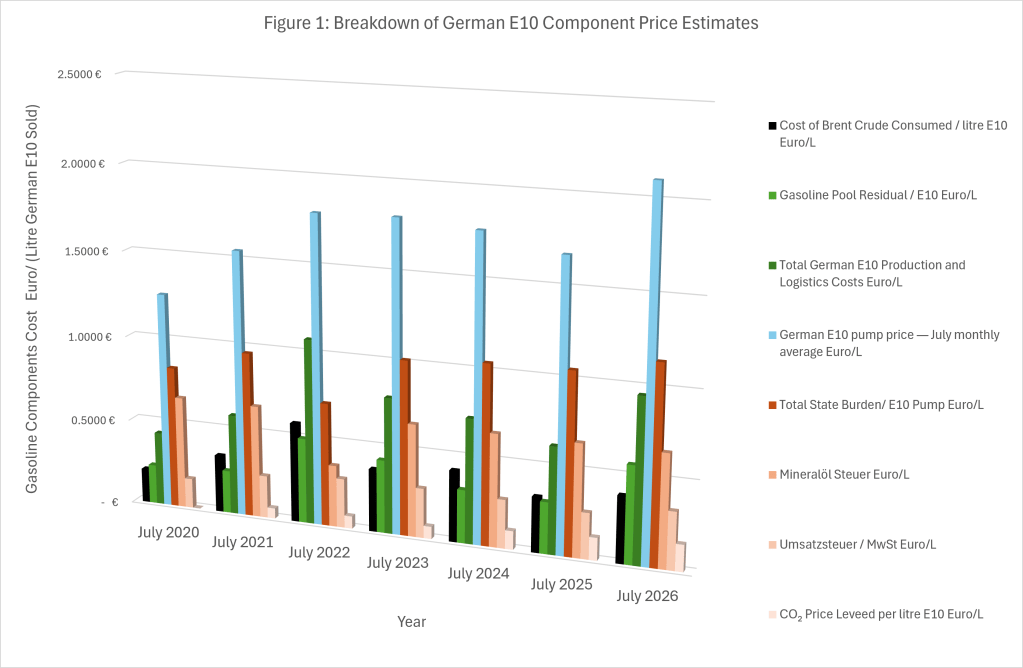
The values are intended for orientation and for identifying changes in the structure of the German E10 price rather than for determining the profitability of individual companies.
Gasoline Pump Price
German E10 prices increased substantially as the economy emerged from the Covid-19 disruption. The period also includes the energy-market disruption following Russia’s invasion of Ukraine and, in 2026, disruption associated with the conflict involving Iran and the United States.
July 2026 is particularly notable because the increase in the E10 pump price cannot be explained by the Brent crude price alone. This raises the question of which other components of the gasoline supply chain changed.
State Revenue
The state-derived portion consists principally of Energiesteuer, CO₂ pricing and VAT. The normal Energiesteuer rate on petrol is quantity-based rather than price-based. CO₂ pricing was introduced in 2021 and progressively increased, although the planned increase was suspended for 2023 in response to the energy-price situation. VAT, by contrast, changes automatically with the taxable pump price.
During the exceptional energy-price conditions of 2022, the German government temporarily reduced petrol Energiesteuer by 29.55 ct/l from June through August. This provides an important example of government intervention when the actual fuel-price environment departed substantially from that anticipated by policy.
Over the complete 2020–2026 period, the model indicates that increases in the state-derived component account for only part of the increase in the E10 pump price.14)
Brent Crude Price
Brent crude fluctuated considerably over the period, with the most conspicuous increase occurring during the 2022 energy crisis. Since 2023, its development has not by itself explained the development of the German E10 pump price.
Gasoline Pool Working Residual
The remaining component is termed the Gasoline Pool Working Residual. It is calculated by difference and must not be interpreted as profit. It must accommodate refinery conversion costs, utilities, hydrogen and chemicals, maintenance, labour, capital recovery, product optimisation, naphtha opportunity value, applicable logistics, commercial margin, profit and modelling uncertainty.
The July 2022 and July 2026 Working Residuals are remarkably similar in absolute value. The composition of the two pump-price peaks is nevertheless very different: Brent contributes much more strongly in 2022, while the state burden is substantially greater in 2026.
The model therefore identifies an anomaly but does not identify its cause or beneficiary.
Instant Replay
Problem Statement:
Why does the peak German E10 pump price spike triggered by the intervention of the USA and Israel on Iran 2025 / 2026 exceeds the spike triggered by the Russian Invasion of Ukraine in 2022.
Referring to Figure 1
- July 2021 and July 2022 bridging the start of the Russian invasion of Ukraine
- July 2025 and July 2026.bridging the start of the intervention of the USA and Israel in Iran
The reduced State burden is observed in 2022 and is already reintroduced for the 2023 observation. The short-term peak in Gasoline Pool Working Residue Peaks in 2022 and declines over the following years up until 2025.
From the model the following table shows critical changes occurring between the monthly snapshot data for July 2021 to July 2022 and July 2025 to July 2026:
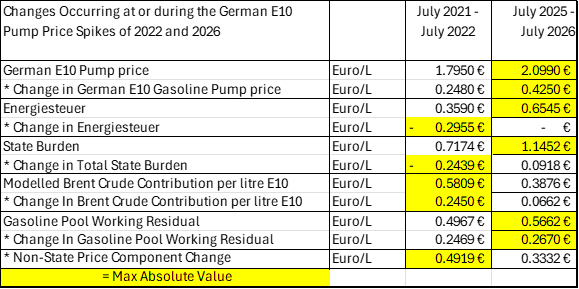
* Change (July 2022 -July 2021) (July 2026 – July 2025)
From the information given in the table yields the following:
- July 2026 E10 was €0.304/L (17%) higher than July 2022.
- The year-on-year pump-price increase was:
- €0.425/L in 2026
- €0.248/L in 2022,
This makes the observed 2026 spike about 71% larger.
- The non-state price-component increase was nevertheless
- €0.3332/L in 2026
- €0.5554/L in 2022
— approximately 40% smaller.
- The difference is largely explained by the state contribution:
- + €0.0918/L in 2026
- – €0.3074/L in 2022
- The absolute Gasoline Pool Working Residuals at the two peaks were remarkably similar:
- €0.5662/L in 2026
- €0.5602/L in 2022
only about 1.1% apart.
- The July 2026 state burden of €1.1452/L was approximately 75% greater than the unusually reduced July 2022 value of €0.6539/L.
What Happened
The comparison reveals an important difference between the two disturbances.
Between July 2021 and July 2022, the combined increase in the Brent crude contribution and Gasoline Pool Working Residual was approximately €0.555/L. However, this was partly offset by a €0.307/L reduction in the state burden, principally resulting from the temporary reduction in Energiesteuer. Consequently, the increase experienced at the pump was limited to approximately €0.248/L.
Between July 2025 and July 2026, the corresponding non-state price-component increase was smaller, at approximately €0.333/L. In this case there was no equivalent reduction in the state burden. Instead, the state-derived component increased by approximately €0.092/L. The resulting increase experienced at the pump was therefore approximately €0.425/L.
The larger 2026 pump-price increase was therefore not caused by a larger increase in the modelled non-state components. Rather, the 2022 market disturbance was partially masked at the pump by temporary state intervention.
Following the 2022 peak, both the Brent crude contribution and Gasoline Pool Working Residual subsequently declined. The temporary Energiesteuer reduction, however, had already been reversed by the 2023 observation. The longer-term moderation of E10 prices between 2022 and 2025 therefore appears primarily associated with changes in the non-state components rather than continuation of the temporary tax intervention.
The level and frequency of the data used in this analysis are insufficient to determine a characteristic recovery or settling time for the German gasoline market.
The annual snapshot data do not establish how quickly the market returns to equilibrium; this becomes important when considering whether the disturbances of 2020–2026 should be treated as independent events or as overlapping disturbances.
Where did the Windfall Fall?
📖 Supporting Sections
- Who’s Cooking the Books with Gasoline? 18.09.2026
- Picky and Choosy 20.09.2026
- The Grass is Greener 21.09.2026
- Supply and Demand (Forthcomming)
- When the Wind Blows TBD (Forthcoming)
- Good Intentions and the Shifting of Influence (Forthcoming)
<= Back │Back to Newsroom│Back to Where did the Windfall Fall │ Forwards =>
Nerd Cheat Sheet: Gasoline Pool Working Residual Model
 Take a Second Thought
Leave a comment