
<= Back │Back to Newsroom│Back to Where did the Windfall Fall │ Forwards =>
Nerd Cheat Sheet: Gasoline Pool Working Residual Model
Within the EU internal market, refinery products can move between Member States without the fuel taxation of the producing country necessarily becoming a permanent component of the product price. For commercial movements, excise duty is generally applied in the country of consumption.
Refining and wholesale facilities in different Member States can therefore compete across national borders, subject to logistics, product specifications, infrastructure and prevailing market conditions.
The analysis can therefore be expanded once again: from the German gasoline/naphtha system to six interconnected European gasoline markets.
The Gasoline Pool Working Residual contains the effects remaining after the modelled raw-material contribution and state burden have been removed. These may include production, transport and distribution costs and risks, trading and inventory effects, commercial margins and profit.
The Working Residual therefore does not provide a direct measure of profit.
The model compares six European gasoline markets using RON 95 E10 where available and RON 95 SUL for Italy. The assumptions and limitations are described in the Nerd Cheat Sheet: Gasoline Pool Working Residual Model.
German E10 prices had generally moderated between the 2022 disruption and 2025. July 2024 has therefore been selected as a pre-2026 reference point from which to examine how the gasoline-price structure changed across the six countries by July 2026.
Figure 4 compares the modelled components of pump price in July 2024 and July 2026, expressed relative to the highest July 2026 pump price among the six countries examined
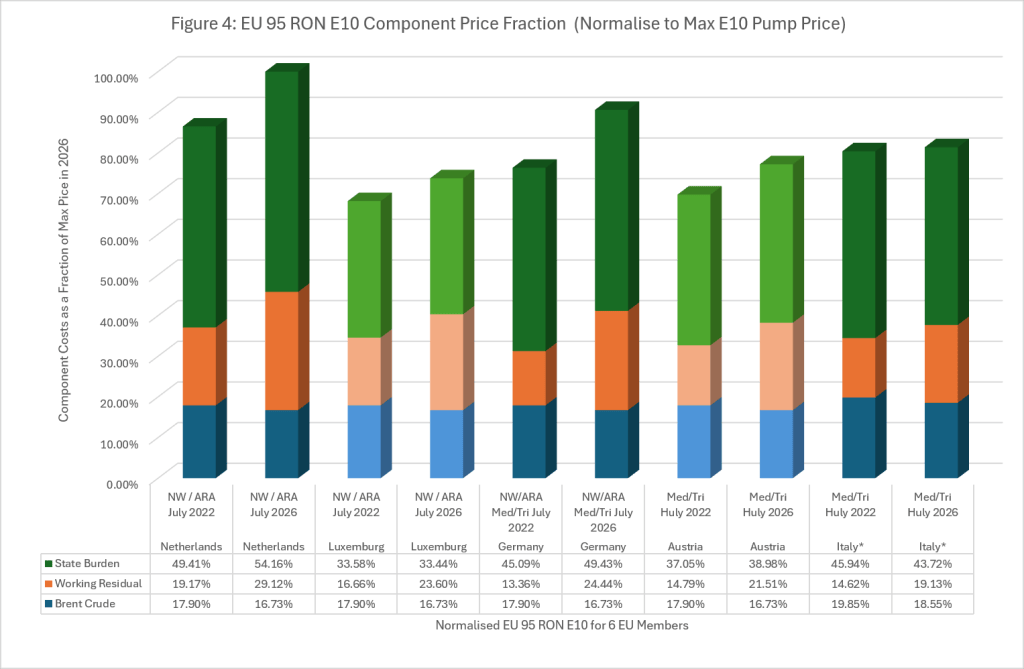
Italy uses RON 95 SUL rather than RON 95 E10.
NW/ARA — Northwest Europe / Amsterdam-Rotterdam-Antwerp
Med/Tri — Mediterranean / Trieste
The following Table shows the model results for Figure 4
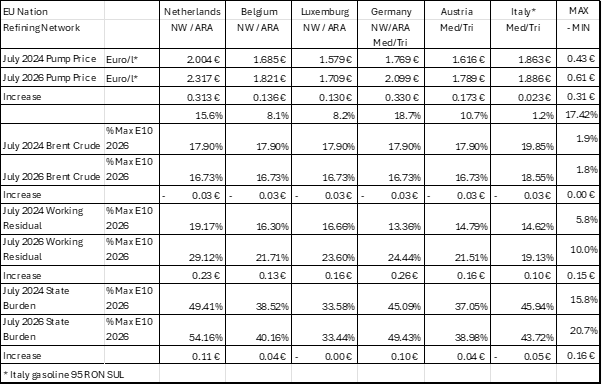
NW/ARA – Northwest Amsterdam-Rotterdam-Antwerp
Med/Tri – Mediterranean / Trieste
What Does Figure 4 Show?
The comparison between July 2024 and July 2026 does not produce an identical pattern in every country. It does, however, reveal several common features.
The modelled Brent crude contribution fell by approximately €0.03/L between July 2024 and July 2026 across the six markets examined. Brent therefore does not explain the increase in pump price observed over this period.
The Gasoline Pool Working Residual, by contrast, increased in all six countries.
The increases were approximately:
| Country | Working Residual increase |
| Netherlands | €0.23/L |
| Belgium | €0.13/L |
| Luxembourg | €0.16/L |
| Germany | €0.26/L |
| Austria | €0.16/L |
| Italy | €0.10/L |
The increase in Working Residual was therefore the largest positive component of the July 2024–July 2026 pump-price change in each of the six markets examined.
National taxation nevertheless changes how this common market movement appears at the pump.
Because VAT is applied to the selling price, an increase in the underlying commercial price also increases the absolute VAT burden unless it is offset by changes elsewhere in the tax structure.
Over the period examined, the model identifies reductions in fuel duty of approximately €0.04/L in Luxembourg, €0.01/L in Austria and €0.06/L in Italy. These reductions directly lower the state burden and also reduce the VAT subsequently applied.
The model also includes changes in national CO₂-price components for Luxembourg, Germany and Austria. These changes act in the opposite direction by increasing the pre-VAT price and therefore also the VAT collected.
Germany and Italy — Same Market, Different Pump Result
Germany provides a particularly useful example.
Between July 2024 and July 2026, the modelled German components changed by approximately:
Brent: −€0.03/L
State burden: +€0.10/L
Working Residual: +€0.26/L
E10 pump price: +€0.33/L
The increase in the German Working Residual was therefore reinforced by an increase in the state burden.
Italy shows how differently the same broader market disturbance can appear at the pump.
The Italian Working Residual increased by approximately €0.10/L, yet the pump price increased by only about €0.02/L, because both the modelled Brent contribution and the state burden declined.
The underlying Working Residual therefore moved in the same direction in both countries, while national taxation altered the final effect experienced by the motorist.
Expanding the Frame Again
The largest absolute component of pump price remained the state burden in all six countries in both July 2024 and July 2026.
However, the largest positive contributor to the change between those two observations was the increase in the Gasoline Pool Working Residual.
This distinction is important.
A large state share of the absolute pump price does not mean that taxation caused the market disturbance. Equally, a rising Working Residual does not demonstrate that the increase represents company profit.
As shown in Picky and Choosey, gasoline is only one outlet within a wider refinery and petrochemical system. Trading, hedging, inventory positioning, logistics, replacement value and other commercial effects may also be contained within the Working Residual and are not separately identified by this model.
The standalone E10 Working Residual therefore cannot be interpreted as the profit generated by an individual refining business.
Petrochemical demand for naphtha provides one example of why the economic frame must be wider than finished gasoline alone. In Germany, refinery and petrochemical facilities form part of an interconnected hydrocarbon system. Petrochemical plants create continuing demand for refinery feedstocks, subject to their own production rates, economics, market demand and availability of alternative feedstocks.
Refineries in turn adjust operating conditions and the allocation and value of products in response to these competing outlets.
The Grass Is Greener — But the Anomaly Travels
Expanding the geographical frame changes the interpretation again.
The 2026 increase in Working Residual is not uniquely German. It appears across all six markets examined, despite substantial differences in national taxation and pump-price outcomes.
At the same time, the six countries do not experience the disturbance equally. Their tax systems, logistics, refinery connections and product markets amplify or suppress how the common market movement appears at the pump.
The analysis therefore suggests that the 2026 anomaly is associated with a wider European market effect rather than a phenomenon confined to the German retail gasoline market.
It still does not establish where the additional value ultimately accumulates or whether it represents profit.
That question requires the frame to be widened again — from where gasoline is sold to how supply, demand, ownership, inventory and value move through the market.
Where did the Windfall Fall?
📖 Supporting Sections
- Who’s Cooking the Books with Gasoline? 18.09.2026
- Picky and Choosy 20.09.2026
- The Grass is Greener 21.09.2026
- Supply and Demand (Forthcomming)
- When the Wind Blows TBD (Forthcoming)
- Good Intentions and the Shifting of Influence (Forthcoming)
<= Back │Back to Newsroom│Back to Where did the Windfall Fall │ Forwards =>
Nerd Cheat Sheet: Gasoline Pool Working Residual Model
 Take a Second Thought
Leave a comment