
<= Back │Back to Newsroom│Back to Where did the Windfall Fall │ Forwards =>
Nerd Cheat Sheet: Gasoline Pool Working Residual Model
The model in Who’s Cooking the Books with Gasoline? examines German E10 as a finished product. A refinery, however, does not produce gasoline in isolation.
Crude oil contains many different hydrocarbons. One of the principal properties used to separate them is boiling point, allowing crude oil to be divided into broad fractions by distillation.
Gasoline itself is a blend of many hydrocarbon components covering a broad boiling range. Light components such as butane can contribute useful blend volume and octane, although their concentration is limited by volatility and vapour-pressure specifications. European gasoline specifications permit a final boiling point of approximately 210°C.
Straight-run naphtha occupies much of the lower part of this boiling range and is generally divided into lighter and heavier fractions according to its intended refinery or petrochemical use.
Naphtha has two particularly important outlets relevant to this analysis:
- as refinery material that can contribute to the gasoline blending pool after appropriate treatment and processing;
- as petrochemical feedstock, particularly for steam cracking to produce intermediates such as ethylene and propylene.
Higher-boiling refinery streams can also be converted into gasoline-range components. Cracking processes break larger hydrocarbon molecules into smaller ones, while hydrotreating is used principally to remove sulphur and condition the resulting streams for further processing or blending.
The consequence is important: the refinery has choices.
The value obtained from different crude fractions depends on prevailing demand, product specifications, facility constraints and the market value of the alternative products that can be made or sold.
A German Story
(Maybe Belgium and the Netherlands too)
Germany contains a network of refining and petrochemical facilities. These facilities cannot be operated independently of their physical constraints. Compressors, reactors, distillation columns and other equipment impose practical limits on throughput and turndown.
For orientation, the model uses an estimated German gasoline/naphtha pool capacity of approximately 41 Mt/y. The derivation and assumptions are given in the Nerd Cheat Sheet: Gasoline Pool Working Residual Model.
Using an assumed German crude-refining capacity of approximately 101 Mt/y, the model derives a gasoline/naphtha pool capacity of approximately 41.1 Mt/y. This value is used as an orientation point when estimating plausible pool loading in the scenarios below.
Being Picky and Choosey About the Modelling
The Nerd Cheat Sheet: Gasoline Pool Working Residual Model describes the model assumptions and limitations.
As in the previous section, the analysis uses July monthly-average snapshot data for the years 2020 to 2026.
Three cases are considered:
- Scenario 1: German Refinery Gasoline Production
E10-equivalent control case. - Scenario 2: Domestic Gasoline + Petrochemical Equivalent
Higher petrochemical-demand sensitivity case. - Scenario 3: Domestic Gasoline + Petrochemical Equivalent
Lower petrochemical-demand sensitivity case.
In detail the scenarios are as follows:
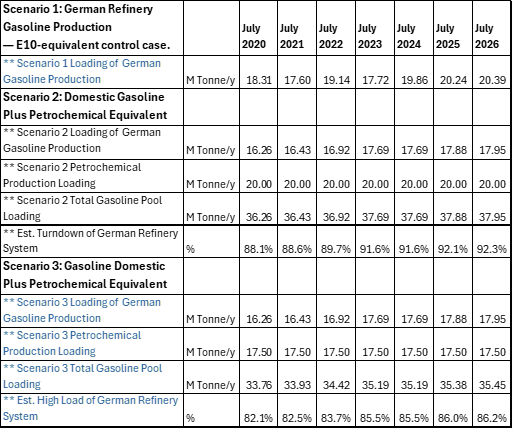
** Scenarios 2 and 3 are not intended to reproduce the actual operation of every German refinery and petrochemical facility. They provide bounded sensitivity cases showing how the calculated Working Residual changes when petrochemical demand is included in the system boundary.
Figure 3 compares the principal modelled components for the three cases.
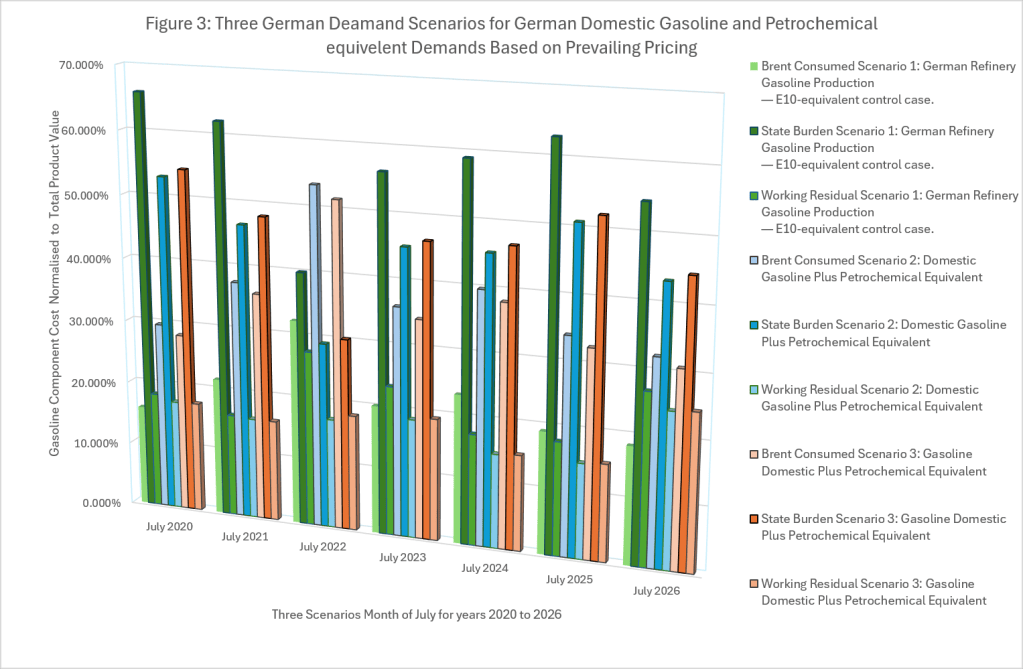
The accompanying table provides the numerical values used to generate Figure 3.

Consequences of Expanding the Frame.
The purpose of Figure 3 is to examine how the calculated Working Residual changes when the system boundary is expanded from E10 alone to include petrochemical demand for naphtha.
Between 2023 and 2025 the modelled Working Residuals generally declined from their 2022 peak before rising sharply again in 2026.
Applying linear interpolation between the annual July observations gives time-weighted averages over July 2020 to July 2026 of approximately:
- Naphtha Working Residual: €19.5/t
- E10 Working Residual: €484/t
The model uses a Rotterdam/Northwest European naphtha price series as its market reference.
The time-weighted Naphtha Working Residual is therefore only about 4% of the E10 Working Residual. Yet petrochemical naphtha accounts for approximately half of the modelled combined pool volume in Scenarios 2 and 3.
This demonstrates why an E10-only Working Residual can substantially overstate the Working Residual of the wider gasoline/naphtha system.
The comparatively small Naphtha Working Residual indicates that, over the period examined, petrochemical demand provides an alternative outlet for material associated with the gasoline pool at a much lower modelled residual than finished E10.
The actual allocation between gasoline and petrochemical use will depend on prevailing market prices, plant configuration, operating constraints and the availability of alternative feedstocks.
It is not the purpose of this analysis to determine the strategic value of the petrochemical industry in Germany. The important point is that refinery gasoline production and petrochemical naphtha demand coexist within the same broader hydrocarbon system.
For orientation, the model therefore combines the two outlets into an overall Working Residual.
The time-weighted averages over July 2020 to July 2026 are approximately:
- Scenario 1 — E10-equivalent Working Residual: €484/t
- Scenario 2 — Combined gasoline/naphtha Working Residual: €235/t
- Scenario 3 — Combined gasoline/naphtha Working Residual: €250/t
Expanding the frame therefore changes the apparent economics substantially.
The following table compares the two disturbance periods:
- July 2021 → July 2022, associated with Russia’s invasion of Ukraine;
- July 2025 → July 2026, associated with the 2026 conflict involving Iran, Israel and the United States.
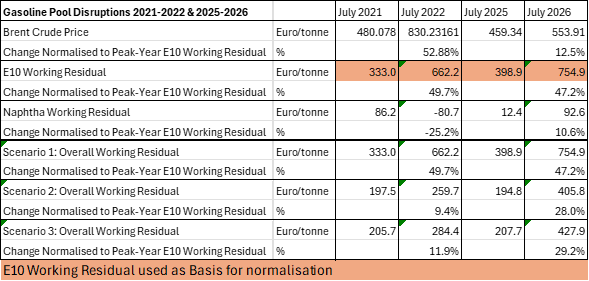
To permit comparison between quantities of different absolute magnitude, the change in each parameter is expressed relative to the E10 Working Residual in the corresponding peak year.
A condensed comparison is:

Expanding the system boundary substantially reduces the absolute Working Residual compared with E10 alone. It does not, however, make the 2022 and 2026 disturbances more alike. It does the opposite.
The model does not reproduce the exact operating configuration of the German refining and petrochemical system in July 2022 or July 2026. Scenarios 2 and 3 instead provide two assumed petrochemical-demand cases that indicate the sensitivity of the result to plausible changes in pool loading.
The overall Working Residuals in Scenarios 2 and 3 are substantially smaller than the E10-only Working Residual in Scenario 1. This reflects the fact that gasoline and petrochemical facilities compete for, or draw upon, related refinery streams.
For orientation, the model treats these outlets as parts of a combined economic system, while recognising that the individual facilities may be owned by different companies and operate under different commercial arrangements.
For all three scenarios, local peaks in Working Residual occur in July 2022 and July 2026. Expanding the system boundary from E10 alone to include petrochemical naphtha, however, substantially reduces the apparent Working Residual of the overall gasoline pool.
The peak working residual in scenario 1 in July 2026 was 14% greater than that seen in in July 2022.
In contrast:
- Scenario 2 is approximately 56% higher in July 2026 than in July 2022;
- Scenario 3 is approximately 50% higher.
The gasoline pool loading was as follows:
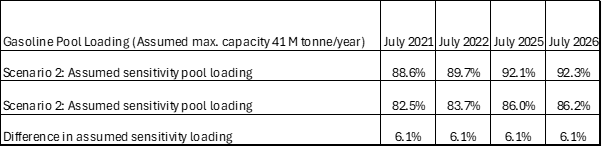
The assumed loading difference between Scenarios 2 and 3 remains approximately 6.1 percentage points throughout the comparison. Its effect on the calculated Working Residual, however, is not constant. Scenario 3 is approximately 9.5% above Scenario 2 in 2022, but only about 5.4% above it in 2026.
The sensitivity therefore depends not only on how the gasoline/naphtha pool is divided, but also on the relative economic value of the competing outlets. In 2022 the E10 and naphtha Working Residuals lie on opposite sides of zero; in 2026 both are positive.
Two Different Disturbances
The character of the two periods is nevertheless different.
Between July 2021 and July 2022, the Brent crude contribution increased sharply while the Naphtha Working Residual moved from positive to negative. The increase in the combined Working Residual was therefore considerably smaller than the increase suggested by E10 alone.
Between July 2025 and July 2026, Brent increased much less strongly. In contrast, both the E10 and Naphtha Working Residuals increased. The normalised combined Working Residual increased by approximately 28–29% in 2025–2026, compared with only about 9–12% in 2021–2022.
The model therefore suggests that the 2022 and 2026 gasoline-price disturbances have different economic signatures.
The 2022 disturbance was strongly associated with an increase in crude value.
The 2026 disturbance is more strongly associated with additional value appearing elsewhere in the downstream gasoline/naphtha system.
The model does not identify where that additional value ultimately accumulates, nor whether it represents profit.
It does, however, demonstrate why the E10 Working Residual cannot be interpreted independently of the wider refinery and petrochemical product system.
Where did the Windfall Fall?
📖 Supporting Sections
- Who’s Cooking the Books with Gasoline? 18.09.2026
- Picky and Choosy 20.09.2026
- The Grass is Greener 21.09.2026
- Supply and Demand (Forthcomming)
- When the Wind Blows TBD (Forthcoming)
- Good Intentions and the Shifting of Influence (Forthcoming)
 Take a Second Thought
Leave a comment