
<= Back │Back to Newsroom│Back to Where did the Windfall Fall
Nerd Cheat Sheet: Gasoline Pool Working Residual Model
CO₂ pricing places a financial cost on the emissions associated with fossil-fuel use. In the case of gasoline, it forms one component of the pump price while also generating state revenue for as long as fossil fuels continue to be consumed.
Figure 1.1 shows the relative shares of the identified state and non-state components of the German E10 pump price.
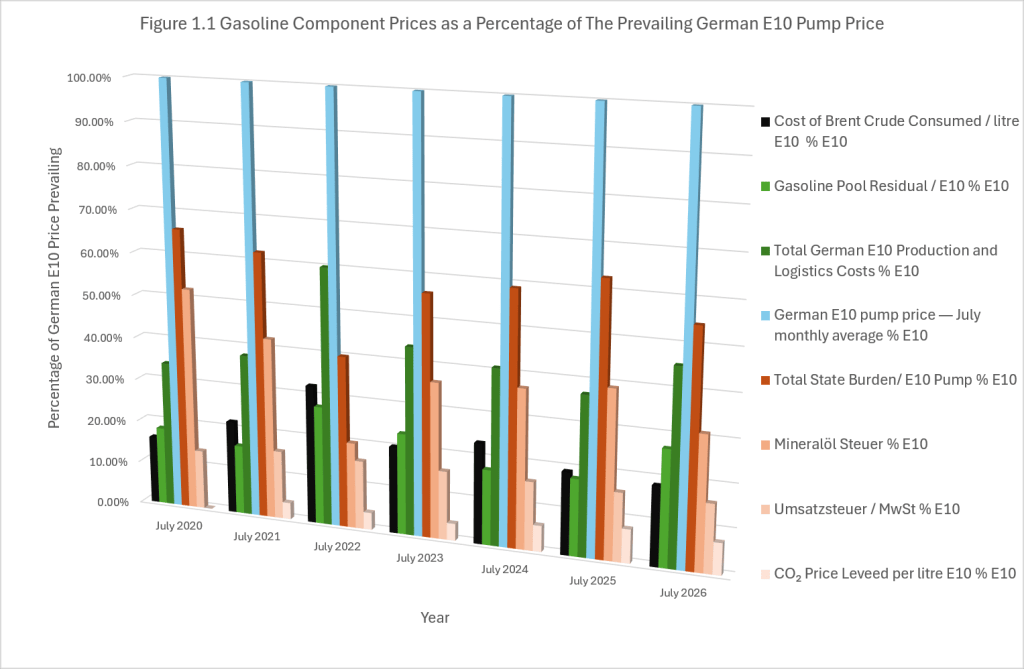

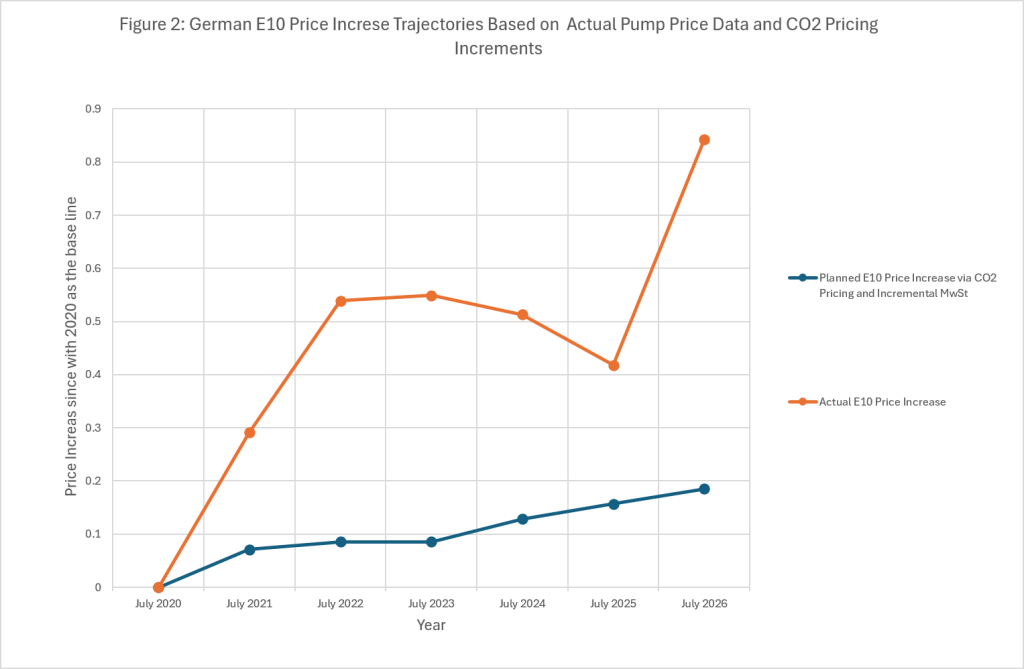
Figure 2 compares the development of the actual German E10 pump price with the progression of the CO₂-price component

Time-weighted average over July 2020–July 2026, assuming linear change between the annual July observations.
If only the additional CO₂-price component were added to the July 2020 E10 price, the reference price would increase from approximately €1.256/L to €1.441/L by July 2026.
The actual July 2026 pump price was €2.099/L.
The comparison is limited by the unusual 2020 starting condition following the Covid-19 disruption. Nevertheless, it illustrates the relative scale involved.
Between 2021 and 2026, German E10 pump-price movements were dominated by factors other than the CO₂-price component.
When the Tail Has to Wag the Dog
Figure 2.1 repeats the comparison using July 2022 as the reference point.
July 2022 is itself an exceptional starting point because it combines severe market disruption with temporary state intervention, but it provides a useful second perspective.
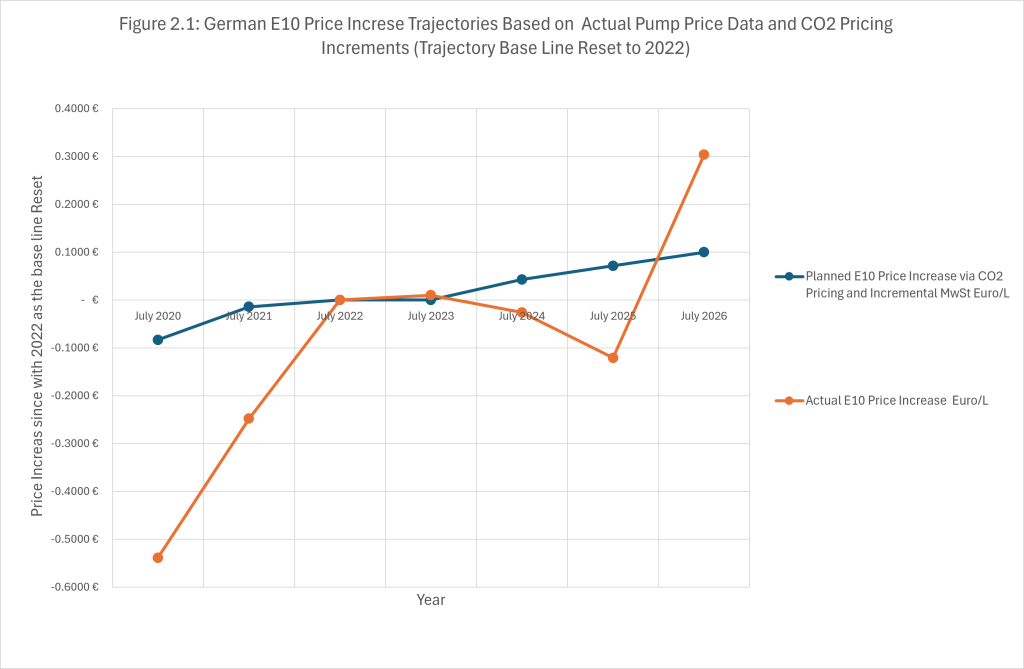
Figure 2.1 shows the same information as Figure 2 except the CO₂-price trajectory and actual E10 pump price have been rebased to July 2022, although July 2022 itself reflects exceptional market conditions and temporary state intervention.

Using the July 2022 E10 price of €1.795/L as the baseline, the CO₂-derived reference trajectory reaches approximately €1.895/L by July 2026.
The actual July 2026 pump price was €2.099/L.
The divergence has two important implications.
Magnitude: the market-generated price movement can be substantially larger than the deliberately introduced CO₂-price increment.
Control: the state can determine the CO₂-price component, but it cannot determine the total pump-price signal experienced by the motorist.
The additional €0.204/L observed in July 2026 is equivalent, purely as an orientation, to roughly eight years of increase at the average CO₂-derived rate observed between July 2022 and July 2026.
This does not mean that €2.099/L was an official future target price. It simply illustrates the relative magnitude of an uncontrolled market-generated signal compared with the deliberately introduced policy signal.
That creates a planning problem.
If unexpectedly high market prices accelerate the decline in gasoline consumption, fuel-related state revenue may fall more quickly than anticipated while demand for alternative infrastructure may arrive earlier.
Conversely, large market-driven price increases can create pressure for short-term intervention intended to reduce the immediate burden on consumers. The temporary Energiesteuer reduction in 2022 provides an example of such a response.
Transition planning must therefore accommodate gasoline-price movements that may be much larger, and occur much faster, than those deliberately introduced through CO₂ pricing.
When the uncontrolled market signal becomes larger than the planned signal, policy may be forced to respond to the market rather than the market responding to policy.
A price-based transition mechanism therefore needs feedback because the market can independently generate, erase, amplify or redistribute the very price signal the policy is attempting to influence.
What If?
The same question of control arises if the state attempts to capture part of an exceptional market-generated gain through a windfall tax.
The following calculation is deliberately conjectural. Its purpose is not to determine actual taxable profit, but to establish an order of magnitude.
The calculation uses the July 2025 and July 2026 monthly-average snapshots and assumes, purely for orientation, that the July 2026 conditions persisted for a full year.
Scenario 3 from Picky and Choosey gives a combined gasoline/naphtha Working Residual of:
July 2025: €207.7/t
July 2026: €427.9/t
The increase is therefore:
€427.9/t − €207.7/t = €220.2/t
The illustrative calculation then makes three deliberately simple assumptions:
- 50% of the increase in Working Residual is consumed by additional costs associated with operating through and managing the disturbance;
- 50% of the remaining amount is attributable to taxable activity within German jurisdiction;
- a hypothetical windfall-tax rate of 50% is applied.
This gives:
| Stage | €/t |
| Increase in Working Residual | 220.20 |
| Assumed remaining as profit | 110.10 |
| Assumed attributable to German jurisdiction | 55.05 |
| Hypothetical windfall-tax revenue | 27.53 |
Applied to a combined gasoline-pool volume of approximately 35.45 Mt/y, the result is approximately:
€0.98 billion per year
or, for the level of precision appropriate to this exercise:
about €1 billion per year.
This is not a forecast, and it is not an estimate of actual taxable windfall profit. It is an order-of-magnitude thought experiment constructed from deliberately simple assumptions.
Statesman, Statesman, Politically Weary — How Does Your Fortune Grow?
Against the orientation value of approximately €1.6 trillion per year used elsewhere in Relativity and Reaction for the total German state burden, €0.98 billion represents approximately:
0.061%
The purpose of this comparison is not to suggest that €1 billion is insignificant.
It is to establish scale.
The more important question is what the intervention is intended to achieve.
A windfall tax could produce several behavioural responses. A company might accept a lower after-tax return, alter investment or commercial decisions, change the timing or location of activity, or seek to recover part of the additional burden through other parts of the business.
The statutory taxpayer can be identified.
Who ultimately bears the economic burden cannot be inferred from the tax assessment alone.
Depending on competition, market structure, timing and behavioural responses, the burden could ultimately be shared between shareholders, customers, employees, suppliers or future investment.
This returns the investigation to the distinction introduced earlier:
Legal incidence tells us who pays the tax to the state. Economic incidence asks who ultimately pays for the tax.
Questions for Policy
The investigation therefore leaves three questions to put to those proposing or considering intervention:
- Do German institutions have sufficient information and authority to identify the root causes of exceptional gasoline-price movements?
- If excess profit is identified, can it be attributed and taxed effectively within German and/or EU jurisdiction?
- What is the objective of gasoline taxation during the 2026 Strait of Hormuz disruption, and how well do the available tax instruments address the prevailing cost drivers?
Where did the Windfall Fall?
📖 Supporting Sections
- Who’s Cooking the Books with Gasoline? 18.09.2026
- Picky and Choosy 20.09.2026
- The Grass is Greener 21.09.2026
- Supply and Demand 23.09.2026
- When the Wind Blows 23.09.2026
- Good Intentions and the Shifting of Influence 23.09.2026
<= Back │Back to Newsroom│Back to Where did the Windfall Fall
Nerd Cheat Sheet: Gasoline Pool Working Residual Model


Leave a comment